タッチポイント
世界的な豊富なケースを持つ業界をリードする特殊通信プロバイダーです。当社の防爆&SIPディスパッチシステムは、プロジェクトを支える信頼できるパートナーであり、実績のある成功を収めています。
閲覧を続ける
知識について
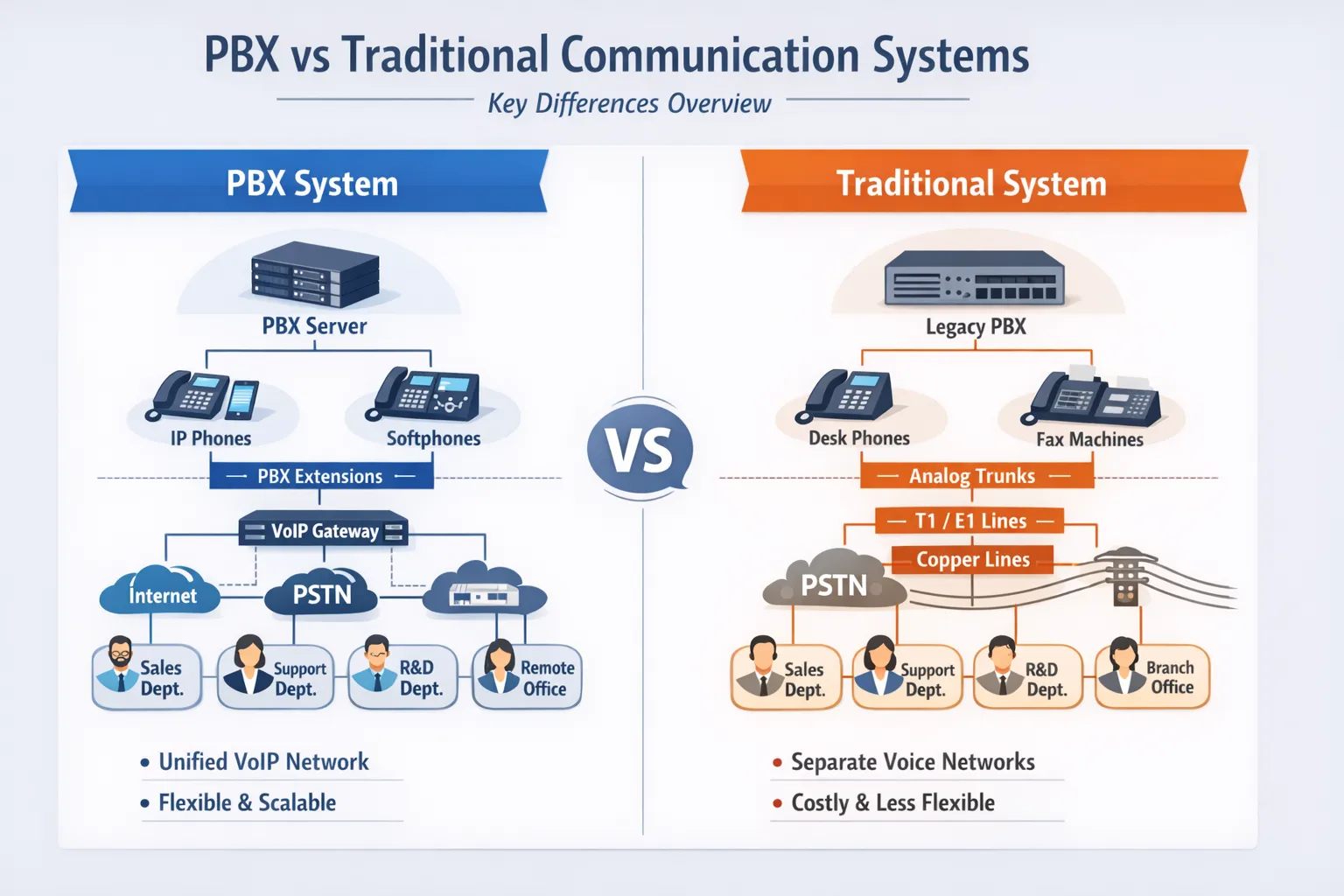
When companies review their communication infrastructure, the discussion often starts with hardware and quickly turns into a question of business process. Who answers the main number, how are calls transferred, what happens after hours, and how do branches work like part of one organization? Those are the practical issues behind PBX vs Traditional Communication Systems Key Differences.
For business users, integrators, and operations teams, PBX should be understood as the control layer behind internal extensions, outside lines, queues, time conditions, permissions, and service continuity. In environments spanning office, branch office, reception, service desk, that control layer determines whether voice communication behaves like an organized business service or just a collection of disconnected endpoints.
This article approaches the topic through the lens of benefits, while keeping the wider project picture in view. The aim is to explain what buyers, planners, and site operators actually need to know: how PBX works, where it adds value, what should be checked before deployment, and how to choose a system that still makes sense after the first year of real use.

A PBX, or Private Branch Exchange, is the platform that organizes how voice communication moves inside an organization and between the organization and the public network. It manages extensions, controls outside access, applies schedules, supports groups and queues, and determines what should happen when a user or caller initiates communication. That central control is what allows a business to behave like one communication system instead of a collection of unrelated numbers and devices.
In practical terms, this means one published business number can support several departments, internal users can operate under a consistent numbering plan, and the organization can enforce route policy instead of relying on manual habits. For organizations in Corporate & Public, that matters because communication influences customer access, internal coordination, after-hours response, and service continuity.
PBX is therefore not only a telecom product category. It is an operating framework that lets businesses define how communication should behave under normal conditions, busy periods, organizational growth, and unexpected disruption.
Even in SIP and IP-based environments, the need for PBX logic does not disappear. In fact, the move to more endpoints, more access paths, and more distributed users often increases the need for a stable control layer. Without that layer, departments tend to keep independent practices, numbers multiply without structure, and caller treatment becomes inconsistent.
PBX prevents that drift by centralizing route policy, permission classes, schedules, and call handling behavior. It turns separate devices and trunks into one manageable voice environment. That is why modern PBX selection still matters in office, industrial, healthcare, logistics, transportation, and public-service projects alike.
PBX becomes most valuable when the organization stops treating telephony as isolated devices and starts managing it as a shared service layer.
The simplest way to understand PBX operation is to look at extensions, trunks, and routing rules. Extensions represent internal users or devices. Trunks provide connectivity to external networks. Routing logic sits in the middle and decides how calls should move according to source, destination, time, permissions, and business policy.
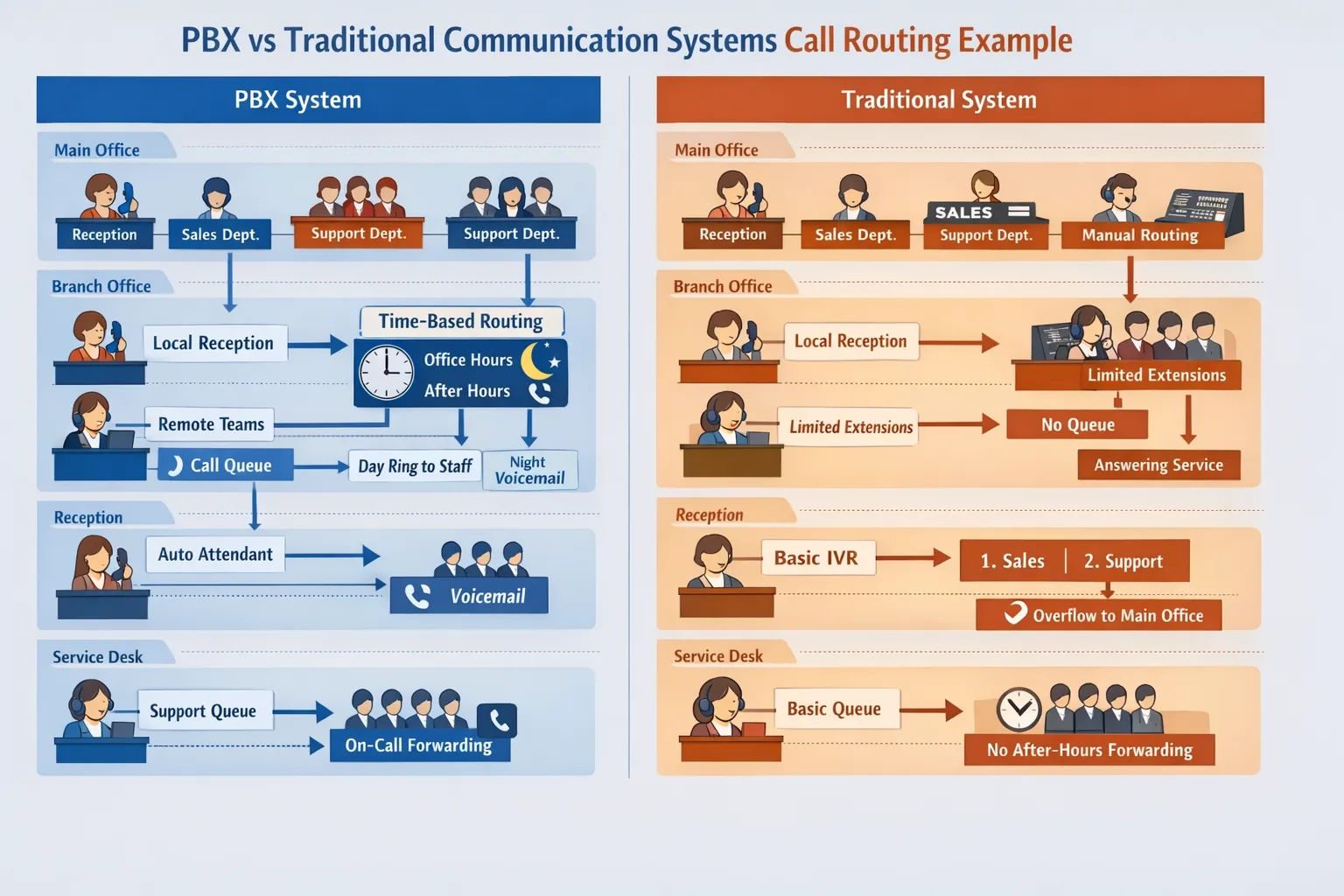
When an internal user dials another extension, the PBX keeps the call inside the private system. When that user places an outside call, the PBX checks permissions and selects the appropriate external path. When an incoming call reaches the business, the PBX determines whether it should ring reception, enter a queue, pass through an auto attendant, or reach a direct extension or group.
This is what makes features such as department groups, overflow rules, forwarding, voicemail, and time-based routing work consistently across the organization rather than as isolated handset settings.
Take a typical customer call to the company main number. The carrier delivers that call to the PBX through a SIP trunk or another access method. The PBX checks the schedule and route design, then decides how the call should be handled. During working hours, that may mean a receptionist, an IVR, or a department queue. Outside working hours, the same number may route urgent traffic to an on-call path and ordinary traffic to voicemail or recorded guidance.
This is one of the clearest reasons businesses deploy PBX. A single external number can support several workflows without forcing every caller through manual transfer. The system creates consistency for the organization and a more orderly contact experience for the caller.

The right PBX for a front-desk office environment may not be the right PBX for an industrial or resilience-sensitive site. In corporate & public projects, selection should begin with the operating model. Who uses the system, which routes are critical, what happens during business peaks, which endpoints must be preserved, and what continuity level is required at each location?
That process reveals whether the project should prioritize queue handling, gateway support, branch consistency, local survivability, or simplified remote administration. It also reveals whether the business is choosing a PBX for office convenience, structured customer contact, specialist site workflow, or a combination of all three.
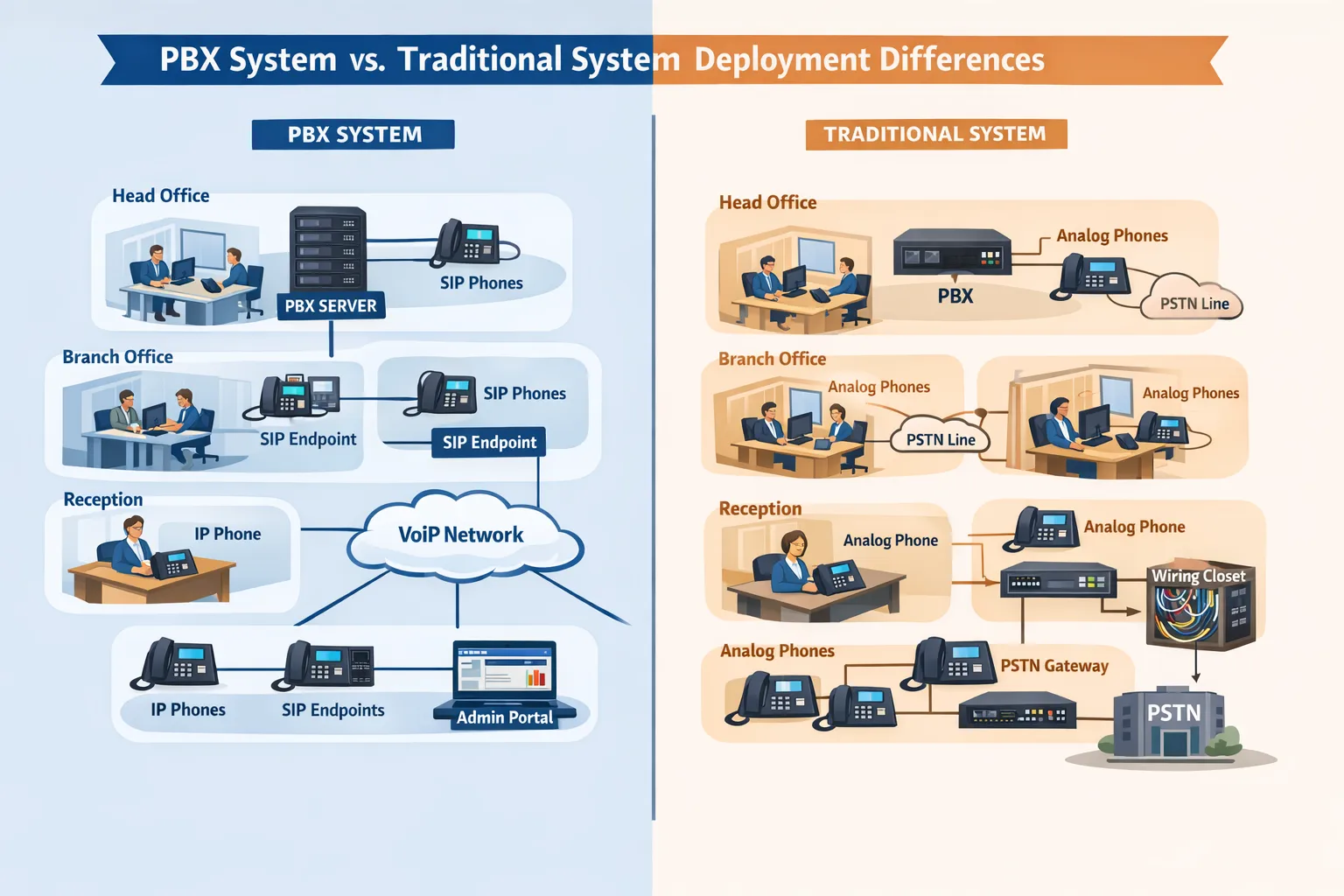
In environments spanning office, branch office, reception, service desk, that distinction matters because not every endpoint or location plays the same role. The system has to reflect those differences rather than flatten them into one generic configuration.
PBX quality depends on more than the PBX itself. Network design, trunk strategy, power planning, administrative ownership, and backup procedures all affect how well the system performs under real conditions. Many disappointing PBX deployments are really cases of weak project preparation rather than weak software.
Buyers should therefore check what happens if the primary trunk fails, if a branch loses connectivity, if the PBX host needs restoration, or if route changes must be made outside normal hours. These questions are not secondary details. They are part of product fit, because a system that only works in ideal conditions is not a strong business communication solution.
If the system does not reflect real operating rules, people end up adapting to the PBX instead of the PBX supporting the business.
It is easy to shortlist PBX platforms by user interface, vendor familiarity, or broad claims about being modern, scalable, or enterprise-ready. Those labels are not useless, but they are far less reliable than direct workflow fit. The better question is whether the platform matches the call paths, user roles, site structure, and service obligations the business actually has today and is likely to have soon.
That is why disciplined PBX selection starts with documented call flows and environment assumptions. Once those are visible, vendor comparison becomes much more meaningful. Without them, the project team is often comparing presentation quality rather than operational suitability.
Selection also improves when mandatory requirements are separated from later-phase ambitions. A business may need clear route control, trunk resilience, and manageable administration immediately, while broader integrations can wait until the basic communication model is stable.
Most underperforming PBX projects have one of three weaknesses: call paths were not defined clearly, network assumptions were not validated, or support ownership was left vague. In those situations, even a technically capable platform can feel disappointing because it was asked to fit a business model that the project never described properly.
To avoid that, buyers should verify endpoint and trunk behavior against real use cases, document how changes will be made after go-live, and make sure the administrative model remains workable over time. PBX projects rarely fail because the idea of PBX is wrong. They fail because clarity was postponed for too long.
For organizations planning structured communication across offices, warehouses, hospitals, campuses, control rooms, transport sites, industrial facilities, or public-service environments, that discipline is often what separates a usable deployment from a corrective redesign.

No. It also improves inbound call handling, outbound control, department routing, after-hours treatment, and visibility over how communication is working.
Yes. Many projects preserve analog phones, hotline circuits, or other retained devices through gateways while modernizing the wider communication architecture.
Not always. Some office environments benefit from hosted models, but industrial, resilience-sensitive, or mixed-estate projects may be better served by on-premise or hybrid designs.
They should define users, sites, call flows, business hours, critical routes, integration needs, and support boundaries first.
If your organization is evaluating PBX for offices, factories, hospitals, campuses, warehouses, control rooms, transport sites, or other business-critical environments, Beck Telcom can help assess call flow, endpoint fit, deployment priorities, and long-term maintainability from a practical project-first perspective.
ラベル:
次へ
メールアドレス:
ホットライン: